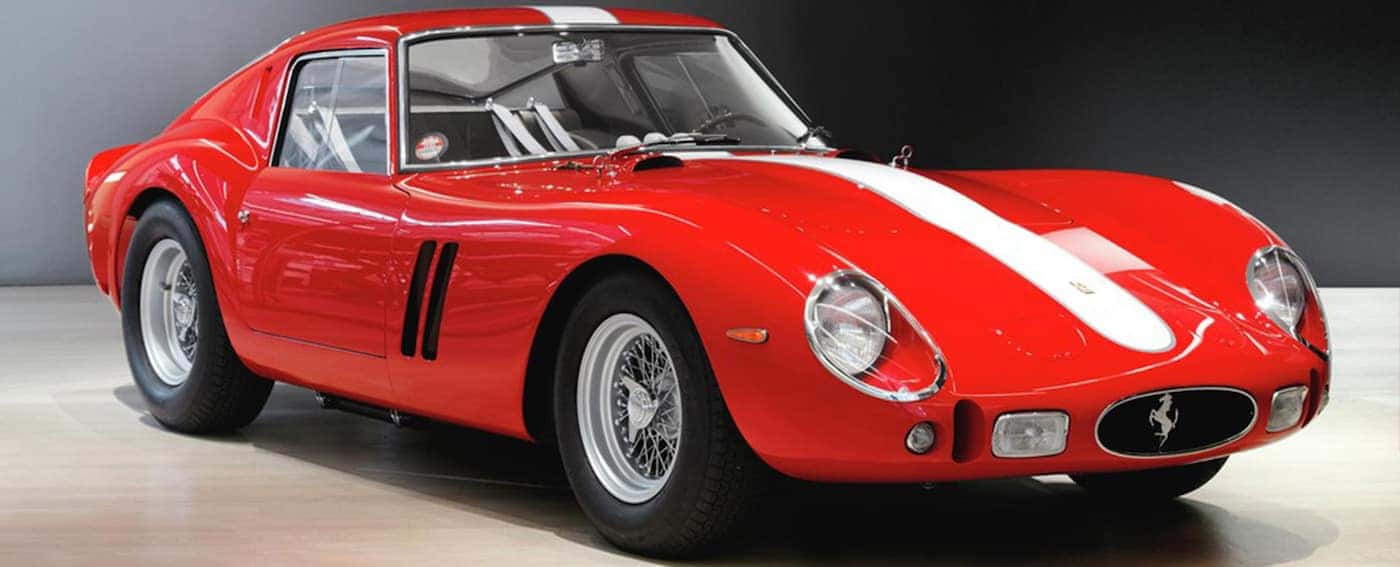
Ferrari is as much about legacy as it is about style and performance, and some collectors will do just about anything to own a piece of that legacy. Whether you simply want a classic Ferrari to call your own or you are interested in a particular part of Enzo Ferrari’s legacy, you’ll be making an investment. We wanted to highlight a few of the most expensive Ferraris ever sold to show how much Ferrari enthusiasts value their own Ferrari Holy Grail.
The fifth most expensive Ferrari ever sold is also unique among the 5 models as the only one that isn’t a Ferrari 250 GTO. In 2016, the Ferrari 335 Sport Scaglietti was the most expensive car ever sold at auction, and is one of only four models produced. The limited nature of the Ferrari 335 only drove part of the demand; after being driven by Peter Collins, Maurice Trintignant, and Wolfgang von Trips, the Scaglietti moved into retirement and was held by a single owner for 40 years.
The level of care, the racing history, and the singular owner all drove demand until the model sold for nearly $36 million.

Positions 4 and 3 on the list of the most expensive Ferraris ever sold are both 1962 Ferrari 250 GTO. Between 1962-64, less than 40 Ferrari 250 GTOs were produced, and buyers were required to be personally approved by Enzo Ferrari. As you can imagine, a limited production Ferrari from the 60s is going to earn quite a bit of attention, receiving a slew of modern accolades, including:
Believe it or not, the Ferrari 250 GTO models regularly sold for four figures in the 60s and 70s until the classic car boom of the 80s and 90s, where this iconic racer became a definitive Ferrari in the eyes of collectors and fans. These models were blue steel ($39.6 million) and Ferrari red ($48.4 million).

With the 4 most expensive Ferraris ever sold all being the same model, even the smallest of differences can lead to massive shifts in value. Nearly $20 million separates two 1963 Ferrari 250 GTO models, and that’s due in large part to the shape it’s in.
Keeping a Ferrari in top condition is one of the surest ways to drive up its value — but if you can win a Tour de France in it, all the better.

You might have heard that the Bugatti La Voiture Noire is the most expensive car in the world, but you might also be scratching your head a bit if you remember its price: $18.7 million. While the one-off La Voiture Noire might have the highest retail pricing, it doesn’t hold a candle to the value of an iconic Ferrari.
As we’ve noted above, some of the most expensive Ferraris are valuable because they’re one of a kind. That’s also what drives that La Voiture Noire retail price so high — there can be only one. So answering the question of the “rarest” car in the world can be difficult, as history has claimed Ferraris and led to select models getting harder and harder to find as the years go on.
There’s not one answer, and in fact there’s probably more than a dozen answers to “what’s the rarest car in the world?” But we can tell you that most of them are Ferraris. From Yahoo Finance to Carlogos, Ferrari claims a handful of spots in nearly every list of the rarest cars in the world.
We know the appeal of the Ferrari 250 GTO, but what’s your Ferrari Holy Grail? Let us know, and we can keep an eye out for it or help you bring it home.
Yes, you can daily drive a Ferrari in the Chicago suburbs, but the answer comes with real caveats. Winter salt, spring potholes, and the daily grind of Sheridan Road traffic aren’t kind to exotic cars, and pretending otherwise would do our clients a disservice. Picking the right model and protecting it properly makes the difference,…
Two of Italy’s most storied marques still build a V12, but they’ve taken very different roads to get there. The 2026 Ferrari 12Cilindri vs. 2026 Lamborghini Revuelto comparison shows how Ferrari S.p.A. and Automobili Lamborghini interpret the same twelve-cylinder heritage in opposite ways. If you’re weighing these two machines, our team at Ferrari Lake Forest…
Owning a Ferrari comes with a level of care and detail that goes beyond the typical car ownership experience, and Ferrari built a digital tool to match that standard. The MyFerrari App is the official Ferrari application for clients, an all-in-one digital companion for vehicle documentation and service scheduling. Whether you’re setting up the app…
