
How to Prepare a Ferrari for Long-Term Storage Beyond Winter
Plenty of owners think of winter as the only reason to park a Ferrari for months. In reality, travel, a second car in the rotation, or a long pause between events can keep a car idle at any time of year. Learning how to prepare a Ferrari for long-term storage means protecting its mechanical condition and its cosmetic quality, and that takes more than throwing a cover over it.
We’ve been a Factory Authorized Ferrari dealer since 1981, so we know what happens when preparation gets skipped. If you want a plan built around your specific car, our service department can help before it goes into storage.
Why Long-Term Ferrari Storage Goes Beyond a Winter Routine
Several months of inactivity is a bigger question than a seasonal routine. It touches the battery, tires and fluids, and it changes how ready the car is to drive.
Modern luxury vehicles have electrical systems that drain the battery even when parked. If the battery dies, vital electronics can be damaged, so a battery tender belongs in any long storage plan. Stationary tires also develop flat spots where rubber settles and hardens.
Heat and humidity take a toll, and so does long inactivity. Chicagoland swings between damp summers and dry, cold winters, and those changes stress seals, metal and interiors. A controlled atmosphere helps prevent cracked dashboards, dried seals, battery corrosion and paint deterioration. Climate-stable storage and UV protection also benefit fine leathers, Alcantara and multi-layer paint.
Some fluids may deteriorate if the car isn’t driven for a long period, so check the owner’s manual. Needs vary with model, age, mileage, and how long the car will sit.
Choose a Temperature- and Humidity-Controlled Storage Environment
Where the car sits matters as much as how you prepare it. Look for a secure, clean space with stable temperature and managed humidity, out of direct sunlight and excess heat, which accelerate wear on leather, Alcantara, trim and paint. It should also offer electrical access for a battery tender and room to inspect the car without moving it unnecessarily.
A heated or climate-controlled space keeps temperature and humidity relatively stable, which helps prevent condensation and corrosion on metal parts. Humidity also ages tires faster by drying and cracking the rubber. For target conditions on your car, refer to the owner’s manual.
Our storage is heated, de-humidified and monitored, and we inspect vehicles weekly. It sits inside our 70,000 square foot Lake Bluff facility and offers year-round protection. We recommend indoor climate-controlled storage over a home garage because of moisture, temperature swings, rodents, and the lack of regular monitoring.
If you are weighing options, contact our team and we will walk through what suits your car.
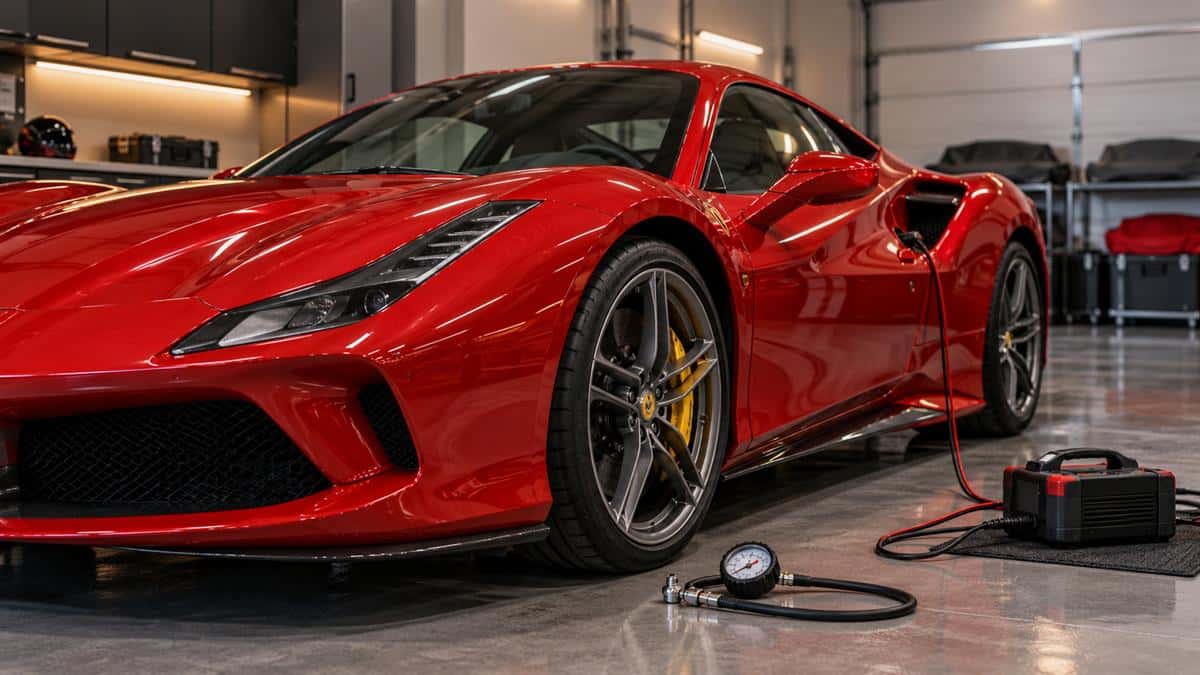
How to Prepare a Ferrari for Long-Term Storage: Step-by-Step
Treat preparation as one coordinated process: clean and dry the car, check its mechanical condition, protect the battery and tires, then cover it only once it is ready to sit. Always follow the owner’s manual, and confirm model-specific procedures with our service team.
Clean the Exterior and Protect the Paint
Left for long periods, dirt, pollen and tree sap can scratch and deteriorate paint, and bird droppings do the same damage faster.
-
Wash with automotive-specific soap, because strong detergents strip wax and dull paint and trim.
-
Use microfiber towels, with a separate towel for each function.
-
Dry thoroughly, including areas where water lingers, so nothing is trapped under a cover.
-
Add a coat of wax, which gives a stored car extra protection.
Ferrari Genuine offers Car Care cleaning kits for the exterior, the interior and touring.
Protect the Interior, Leather and Cabin
Check the owner’s manual first. Start by vacuuming the crevices, then use a colorless microfiber towel and Ferrari-recommended leather cleaner. Avoid household cleaner, furniture polish, harsh detergents, dark towels and sharp objects, since they can damage delicate leather.
For Alcantara, use a dedicated cleaner and a soft brush, and avoid silicone products. Remove food and anything else that could attract pests. Ferrari recommends using the sanitizer periodically and changing the anti-pollen filter. If your 296 GTB has the cabin cover set (seat covers and steering wheel cover in bielastic fabric), remove it before driving.
Address Fuel and Fluid Condition
-
Fill the tank if storing more than 30 days, which limits moisture in the tank and keeps seals from drying out.
-
Consider a fuel stabilizer, which helps protect against gum, varnish and rust. Use and duration vary, so confirm with us.
-
Check engine oil, coolant, brake fluid and power steering fluid levels.
-
Consider an oil and filter change before storage. Used oil carries combustion byproducts and moisture that sit against internal surfaces for however long the car rests, and fresh oil doesn’t. It isn’t a Ferrari requirement, but it’s cheap insurance on an engine that will sit for six months.
Ferrari Genuine Maintenance covers scheduled maintenance labor, original spare parts, engine oil and brake fluid. Annual inspections are done by Ferrari-trained personnel using factory-approved diagnostic equipment. Leave fuel-system and brake work to authorized technicians. Sorting out overdue service before parking beats discovering it at recommissioning.
To have the car properly prepared, schedule service with Ferrari Lake Forest before or after extended storage so it is ready to return to the road.
Use the Right Battery Maintainer
Ferrari Genuine offers a battery conditioner that supports batteries between 1.2Ah and 140Ah. It has a power-limiting function: if temperature exceeds the safety threshold, output is limited until it returns to the correct range. Genuine Ferrari battery conditioners maintain charge and combat sulfate crystal growth, and should be used any time the car is parked for long periods.
Models without a factory charger plug can have an aftermarket adapter installed by a service department. We connect every stored vehicle to battery tenders that maintain charge without overcharging.
Check Tire Pressures and Prevent Flat Spotting
Inflate tires to the recommended pressure in your owner’s manual. Flat spotting occurs faster in cold temperatures and on performance or low-profile tires, which many Ferraris wear. Driving until the tires reach operating temperature can eliminate some flat spots, but short moves are no substitute for proper tire care.
Check pressure monthly with a gauge and expect a gradual loss of one to two PSI. Jack stands take load off the tires entirely, which eliminates flat spotting rather than slowing it, and they’re worth considering for storage past six months. Ferrari doesn’t mandate them, and they require proper lift points, so confirm placement for your model before using them. For stored vehicles, we monitor tire pressure, maintain proper inflation and condition the rubber.
The parking brake deserves a note. Leaving it engaged for months can cause pads to bond to the disc, so where your manual allows it, chock the wheels and release the brake instead. Cars with carbon ceramic discs are worth extra attention here, since replacement costs run well into four figures and the discs are sensitive to moisture sitting against pad material.
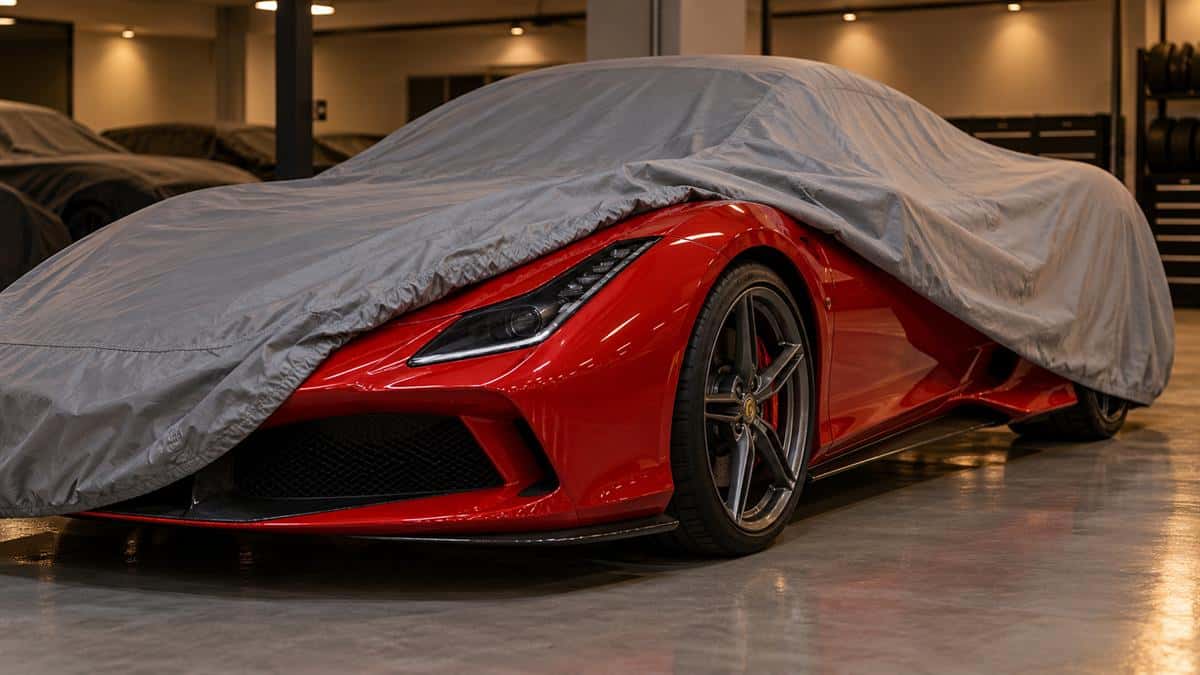
Choose a Breathable Cover and Block Pests
Use a clean, well-fitting, breathable cover on a fully dry car. Ferrari Genuine’s 296 GTB indoor dust cover is custom-fit and breathable with an antistatic finish. The 458 Spider indoor cover instead adds an inner anti-scratch lining. Never use plastic tarps or non-breathable covers, which trap moisture against the paint.
For pests, seal entry points around the storage space and inspect regularly. Steel wool in exhaust tips and intake openings works, and so does keeping the area free of anything edible. Avoid mothballs and poison baits inside the car itself, and never block ventilation.
Model-Specific Ferrari Storage Recommendations
Conventional and hybrid powertrains call for different plans. Tire specifications, cabin materials and maintenance schedules also differ across models and years. For rare or historically significant cars, document condition and follow preservation guidance suited to originality.
| Model or group | Battery guidance | Key storage consideration |
|---|---|---|
| 296 GTB, 296 GTS, SF90 Stradale, SF90 Spider | Keep the Ferrari-approved charger connected and avoid prolonged deep discharge | Enable long-parking or storage mode where available. Hybrid systems monitor battery status while parked, so a temperature-stable space matters more |
| F8 Tributo, GTC4 Lusso, 812 Superfast, Portofino and Portofino M, Roma, Monza SP1 and SP2, Purosangue | Ferrari Battery Conditioner fits models equipped with a lead acid battery | Standard conditioner protocol applies |
| 488 | Maintain the battery periodically | Neglect can cause irreversible loss of functionality, so this isn’t optional |
| F12 Berlinetta | Avoid battery problems or disconnection | Disconnection can affect ECU software, trigger error codes, and cause data loss |
Hybrids keep monitoring battery status while parked. MyFerrari Connect lets owners remotely monitor high-voltage battery percentage, charging status and electric range, though some connectivity features may become temporarily unavailable if charge falls too low. High-voltage work belongs with authorized technicians, never DIY.
Storage duration guide
-
Under 3 months: Focus on a clean car, a battery tender, correct tire pressure and a breathable cover.
-
3 to 12 months: Add a fluid review, monthly tire checks and periodic visits to confirm equipment is working.
-
Over a year: Add a professional pre-storage service review and a return-to-road inspection.
Requirements vary by model, so confirm with the manual and our service team.
Bringing Your Ferrari Back on the Road: Pre-Drive Checklist
Before you start the engine, walk through this list:
-
Inspect the car and storage area for leaks, moisture, pests and visible damage.
-
Remove cabin covers.
-
Check fluid levels and tire pressures.
-
Reconnect the battery and confirm status.
-
Check exterior lighting and warning messages.
-
Confirm scheduled maintenance status.
-
Follow the manual’s warm-up procedure.
-
Test the brakes gently, per the manual.
Hybrid owners can monitor battery status through MyFerrari Connect during infrequent driving. Ease into the first drive and check braking and handling before demanding peak performance. A professional inspection adds confidence after extended storage. You can schedule service for a return-to-road check.
Schedule Ferrari Storage Service with Ferrari Lake Forest
Schedule service with Ferrari Lake Forest before or after extended storage so your car is properly prepared and ready to return to the road. Factory-trained technicians at our award-winning service center, a 2024 Ferrari Global Service Award recipient, should handle hybrid high-voltage systems and pre-return inspections, along with any fluid changes before storage.
Owners can schedule service while the car remains stored, and Ferrari Master Technicians handle oil changes, inspections and routine maintenance on-site without the car leaving the building. For owners outside the area, we arrange transportation for pickup, service, and return.
Visit or Call Us
Visit us at 990 N Shore Dr, Lake Bluff, IL 60044, call (847) 295-6560, or schedule service online. Hours are Monday to Friday 7:00 AM to 5:00 PM and Saturday 9:00 AM to 1:00 PM. Always follow your owner’s manual, and confirm model-specific procedures with our service team.
0 comment(s) so far on How to Prepare a Ferrari for Long-Term Storage Beyond Winter