
How the Ferrari 849 Testarossa’s Active Aerodynamics Work
Ferrari 849 Testarossa active aerodynamics come down to one moving part and a lot of carefully shaped fixed ones. A rear spoiler changes configuration in under a second, while the underfloor, splitter, and diffuser keep shaping airflow the whole time. At Ferrari Lake Forest, we talk with Chicagoland enthusiasts about this system often, so here is how it works.
If you want to talk through any of it in person, contact our team at our Lake Bluff dealership.
Why Ferrari 849 Testarossa Active Aerodynamics Define the Car
Ferrari set two aerodynamic goals: better thermal performance and more downforce, using solutions drawn from racing. The results are 415 kg of total downforce at 250 km/h, 25 kg more than the SF90 Stradale, alongside a 15% improvement in cooling. Airflow decides how the car grips and how its hybrid powertrain holds temperature, and on this car those aren’t separate problems.
Downforce is the aerodynamic load that presses the tires into the road, which helps grip and stability. Drag is the air resistance the car must push through, which costs efficiency. More of one usually means more of the other, so Ferrari engineered a system that adjusts the balance instead of fixing it.
What Active and Passive Aerodynamics Mean on the 849 Testarossa
Passive aerodynamics are fixed surfaces, and they shape airflow identically whatever the car is doing. Active aerodynamics change position. On this car, the rear spoiler is the only active element. Everything else is passive: the underfloor, splitter, twin tails, diffuser, fences, and vortex generators.
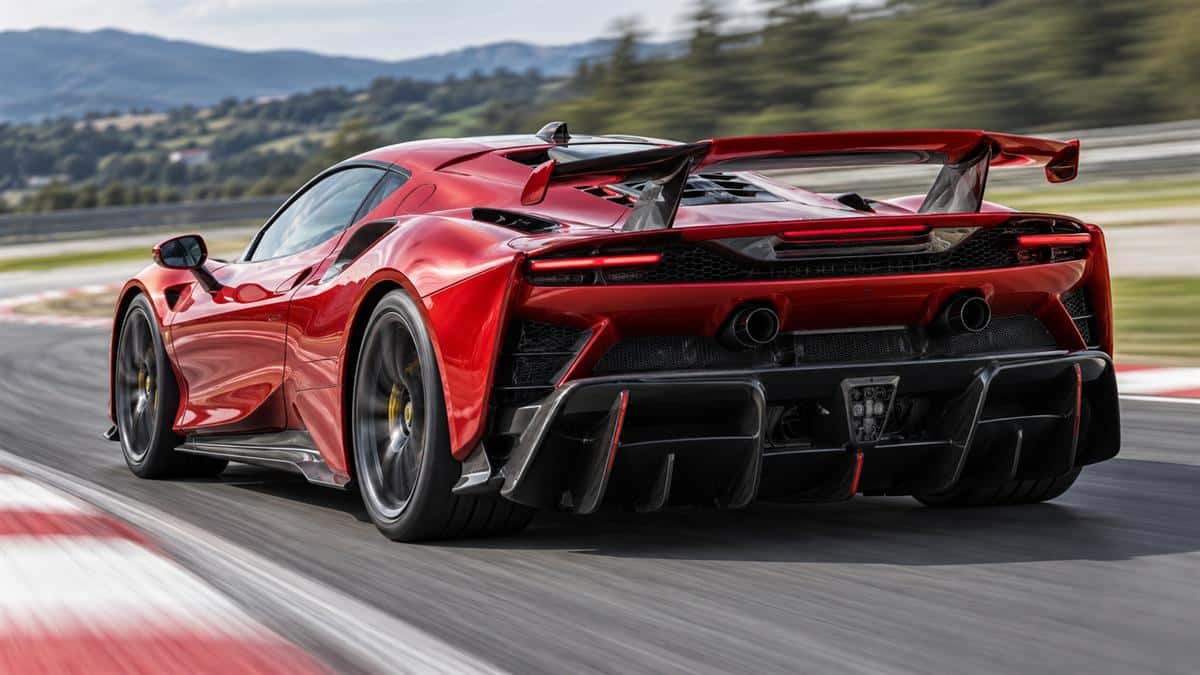
Active Rear Wing: Adjusting Downforce and Drag on Demand
The rear spoiler derives from the SF90 Stradale’s, with a mechanism 2 kg lighter than its predecessor’s. Rather than forcing one aerodynamic compromise on every situation, it switches between two configurations. It doesn’t work alone: its effect depends entirely on the airflow the front bodywork, underfloor, and rear diffuser deliver to it.
Low Drag and High Downforce Positions
Ferrari names the two configurations Low Drag and High Downforce. Low Drag lets the car move through the air with less resistance, which suits situations where extra load on the tires isn’t needed. High Downforce raises the rear load and, according to Ferrari, contributes up to 100 kg at 250 km/h.
The spoiler switches between the two in less than a second. In High Downforce it also works with the passive tail elements. The rear tails integrated with the active wing are a patented solution, and the integration lets the rear act as one coordinated system.
When the Wing Moves: Speed, Braking and Cornering
Ferrari specifies the two configurations, the under-one-second transition, and the 100 kg figure at 250 km/h. Ferrari doesn’t publish exact trigger points. What we can explain is why the two settings exist.
Extra rear downforce keeps the car settled at speed. Braking is helped too, since it adds load on the rear tires, and in corners that added load helps the tires hold their grip. Low Drag gives the load back when the car doesn’t need it, so you don’t carry maximum aerodynamic resistance all the time.
Passive Aero Solutions: Underbody, Diffuser and Vortex Generators
Much of the downforce comes from parts you rarely see. A vortex generator is a small fixed feature that organizes airflow into controlled swirls. A diffuser is the shaped rear section of the underbody that manages how air exits and helps create low pressure beneath the car. Together these surfaces produce grip without relying only on the movable spoiler.
The front underfloor is responsible for 35% of total downforce. Ferrari completely redesigned it with three pairs of cascading vortex generators that maximize outwash and intake. The result is 20% more downforce than the SF90 Stradale.
At the rear, the underfloor delivers downforce aligned with the SF90 Stradale’s and cuts drag by 10%. The rear underbody uses a multi-level diffuser with a suspended lower element. Vertical fences isolate wheel wake, and a pair of long-chord vortex generators sits around the rear axle.
Two contributions that haven’t been covered: the front splitter carries a flick inspired by the SF90 XX Stradale, good for 10% of front downforce, and the twin tails add another 10% at the rear, working the flow over the rear wheelarches. Even the forged wheels were developed with Ferrari’s aerodynamics department to help extract wheel-well air and control the wake. The twin-tail architecture traces to the 512 S.
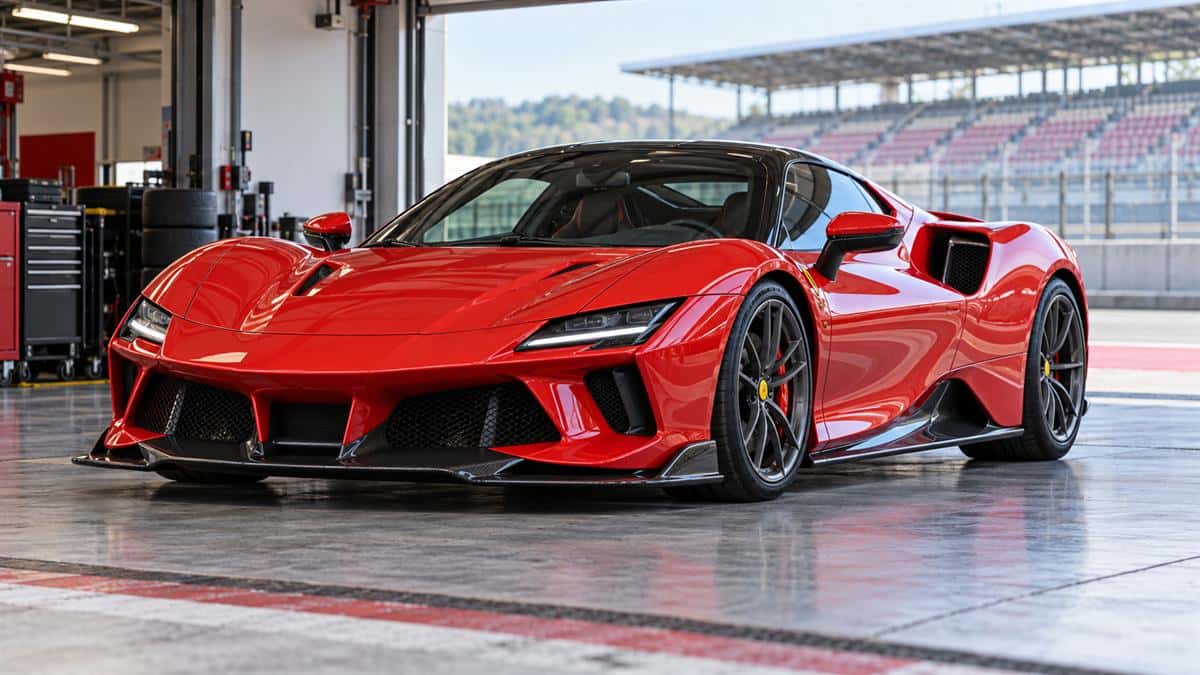
Front-End Airflow, Cooling, and Cabin Channels
Air that produces grip and air routed for cooling both shape the car. Ferrari made thermal management part of the exterior design, which matters for a hybrid powertrain with intercoolers, radiators, and brakes to keep cool.
At the front, the air intake is enlarged by 18% for the radiating masses. Integrated bumperettes direct air toward the front intakes and create vorticity that extracts air from the wheel arch. Internal vertical baffles prevent flows from mixing and help stiffen the bumper. Wheel-arch and underfloor vents were repositioned, a vortex generator promotes extraction through the central louvers, and a nolder (a small lip that redirects flow) increases flow through the side louvers.
The sides matter just as much. Body-side volumes increase airflow to the intercoolers by 30%. The door works as an aerodynamic duct, with design language inspired by 1970s Sports Prototypes. Its channel feeds the lower intercooler, and a blow on the duct’s lower surface captures the boundary layer. The side intake also supplies the rear brake duct and engine intake. The side intercooler is borrowed from the F80 and is 19% larger.
At the rear, three slots in the side trim and a bumper vent use wake pressure to extract engine-compartment air. Two slots near the spoiler and three in the rear bumper ventilate the engine compartment and cool bumper electronics. The rear wheel arch takes inspiration from the Ferrari Purosangue and evacuates high-pressure air, which reduces drag.
Brake and Radiator Cooling
The front brake intake sits in the upper part of the duct, separated by a horizontal section. A parking-sensor fairing channels air toward both the brake intake and the radiator, a small detail that does two jobs.
At the rear, a flank intake increases airflow to the new rear brake caliper by 70%. Ahead of the side louvers, an excavation works with the nolder to extract hot air from the front compartment. It also reduces compression against the front of the tire, which lowers drag.
How Ferrari Motorsports and Earlier Road Cars Shaped the System
Ferrari’s motorsport experience informs an approach where aerodynamic efficiency and cooling are developed together with vehicle dynamics. That heritage reaches into the engineering as well as the styling.
The active spoiler traces to the SF90 Stradale, and the front flick to the SF90 XX Stradale. The side intercooler comes from the F80, the rear wheel arch from the Purosangue, and the twin tails from the 512 S. If you’re curious about earlier Ferraris, our pre-owned selection is a good place to explore.
Lessons From Hybrid Halo Cars and the SF90 Stradale
The plug-in hybrid architecture is derived from the SF90 Stradale, which the 849 Testarossa replaces. That car established the pairing of a twin-turbo V8 with electric motors and an active rear spoiler. The newer car refines how those systems respond together, using that hybrid base as its starting point.
Aero, Powertrain, and Driver Controls Working Together
Aerodynamic grip is one part of a larger package. The Ferrari 849 Testarossa engine is a twin-turbo V8 paired with three electric motors. The electric motors deliver 220 cv, and the combined system delivers 1,050 cv. The front-axle motors form the RAC-e system, which enables four-wheel drive and torque vectoring for traction and efficiency exiting corners.
Ferrari’s FIVE estimator estimates speed and other quantities that can’t be measured directly. It feeds vehicle-dynamics controls so their responses are more precise and repeatable. All of this happens in the background, with no wing control for you to operate. ABS Evo is active in all Manettino positions and grip conditions. Improved speed estimation helps the car use tire forces in straight-line braking and in combined braking and turn-in.
The eManettino offers eDrive, Hybrid, Performance, and Qualify modes, and the digital cluster allows rapid reconfiguration. Modes change how the hybrid powertrain delivers performance, but road surface and tire grip still decide how much the car can use. Ferrari also optimized shock-absorber damping in virtual and physical sessions replicating road and track driving.
Curious how these systems fit your driving? Ask our team about the specs that matter to you.
Road vs. Track Behavior and the Assetto Fiorano Pack
The optional Assetto Fiorano pack is available on both the coupe and the Spider. It adds larger front flicks and an additional pair of front-underfloor vortex generators. At the rear, twin wings with high-incidence profiles set between vertical endplates replace the twin tails, a configuration Ferrari traces to the 512 M and the FXX-K. Vertical downforce triples against the twin tails with minimal drag penalty.
For owners who plan real track time, that’s the option to discuss. For road-focused owners, the standard configuration already carries the 415 kg figure at 250 km/h.
Coupe vs. Spider: Aerodynamics of the Open-Top 849 Testarossa
An open-top body changes how air moves around the cabin, since there’s no fixed roof to guide it. Ferrari solved this with specific hardware. With the roof closed, a rear tonneau-cover bridge channels airflow toward the rear engine cover and spoiler. With the roof open, a patented wind stop in the rear bench captures airflow above the side window.
The Spider’s spoiler derives from the SF90 Stradale and 296 GTB and also switches in under a second. Ferrari’s aerodynamic references for the Spider include the 512 S, 512 M, and FXX-K. The 849 Testarossa Spider matches the coupe’s downforce and cooling figures.
| Model | Powertrain | Power (cv) | Aero notes | Roof type |
|---|---|---|---|---|
| Coupe | Twin-turbo V8 plus three electric motors, plug-in hybrid architecture derived from the SF90 Stradale | 1,050 combined (electric motors 220) | 415 kg downforce at 250 km/h, 15% better cooling, active rear spoiler with Low Drag and High Downforce settings in under one second | Fixed coupe roof |
| Spider | Same architecture | 1,050 combined | Same 415 kg and 15% figures, spoiler derived from the SF90 Stradale and 296 GTB, tonneau-cover bridge with roof closed, patented wind stop with roof open | Retractable hard top, opens or closes in 14 seconds at speeds up to 45 km/h |
Both bodies share the same priorities of stability, cooling, and balanced airflow, but they reach them through different details.
Learn More About the 849 Testarossa at Ferrari Lake Forest
Talk Aerodynamics With Our Team
Ferrari 849 Testarossa active aerodynamics are easier to appreciate once you see the car and talk through how it suits your road or track plans. As a Factory Authorized Ferrari dealer since 1981, we welcome your questions on the aerodynamic features, configurations, and the Assetto Fiorano pack. Allocation is limited, so if you’re searching for a Ferrari 849 for sale, reach out to us about availability.
Visit Us in Lake Bluff
Visit our 70,000 square foot facility in Lake Bluff, home to a large indoor Ferrari display, or call (847) 295-6560. Nationwide transportation is available for buyers outside Lake Forest and Chicagoland.
0 comment(s) so far on How the Ferrari 849 Testarossa’s Active Aerodynamics Work