
Inside the 2026 Ferrari Amalfi Safety Features: Driver Assistance, Braking, and Control Systems
The 2026 Ferrari Amalfi pairs driver assistance, brake-by-wire braking, and a coordinated set of stability controls. Together they support an engaged driver without dulling the drive. This guide explains what each system does in plain terms. For specifics on a particular build, contact our team at Ferrari Lake Forest.
2026 Ferrari Amalfi Safety Features at a Glance
We group the Amalfi’s safety technology into driver assistance and braking, with stability controls handling grip and vehicle motion. The driver assistance group is known as ADAS (advanced driver assistance systems), and it warns you or steps in to help. Braking relies on brake-by-wire and ABS Evo. A feature list can’t prove crashworthiness or guarantee collision avoidance, so we treat equipment and effectiveness as separate questions.
| System | Function | Driver Benefit | Standard/Optional |
|---|---|---|---|
| Adaptive Cruise Control | Assists with speed and following distance | Less routine workload on the highway | Standard |
| Automatic Emergency Braking | Responds to detected collision risk | Added backup for an attentive driver | Standard |
| Blind Spot Detection | Warns of nearby traffic | Extra awareness before lane changes | Standard |
| Lane Departure Warning / Lane Keeping Assist | Warns of lane drift, may assist steering | Alerts you to unintended drift | Standard |
| Brake-by-wire with ABS Evo and EBD | Electronically managed braking | Shorter pedal travel, better modulation | Standard |
| VDC, F1-TCS, E-Diff3, SSC 6.1, FDE 2.0 | Coordinated vehicle controls | Help manage available grip | Standard |
| Surround View | Camera-based visibility aid | Easier low-speed maneuvering | Optional |
| Rear Cross Traffic Alert | Warns of crossing traffic when reversing | Added awareness in parking lots | Optional |
Amalfi Naming and US Availability: What to Confirm
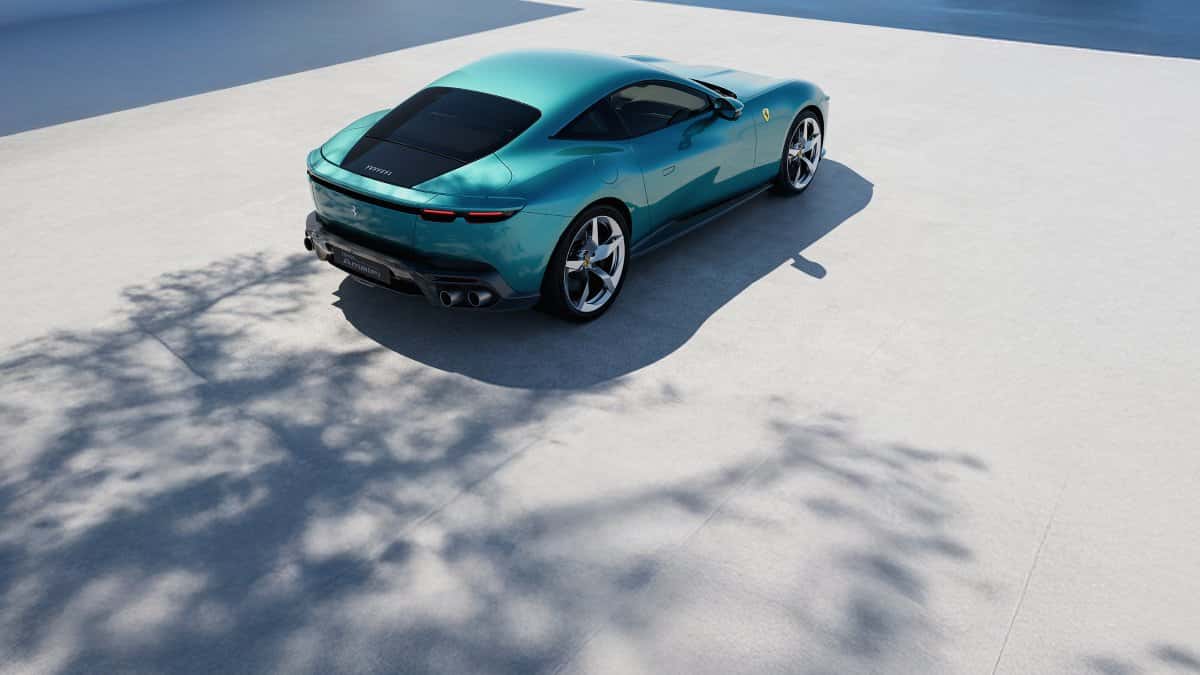
Ferrari calls the car simply the “Ferrari Amalfi,” with no model year in its name, and presents it as the Roma’s replacement. In the US, the Amalfi is sold as a 2027 model, though many shoppers search for it as the 2026 Amalfi. Delivery timing depends on allocation, and we can give you the details for any specific car.
Amalfi Driver Assistance: Aids, Not Autonomy
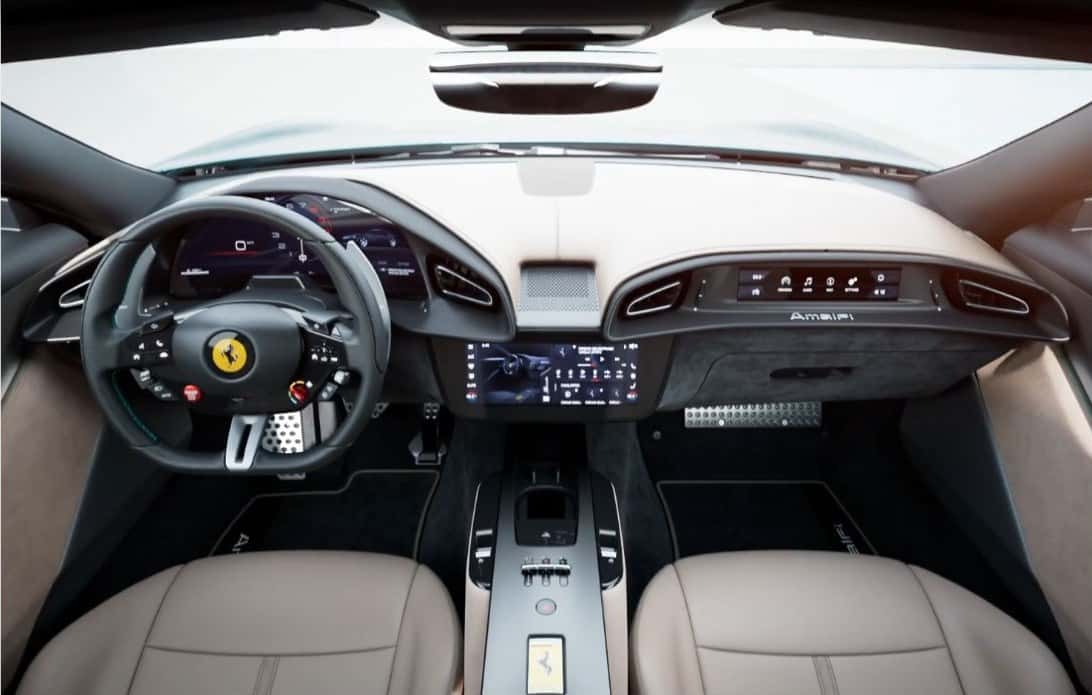
The Amalfi’s driver assistance works best with an attentive person at the wheel. This is a set of aids with no autonomous driving, and nothing in it guarantees control or crash prevention. You remain responsible for steering, observation, speed, and stepping in on time. The core suite is standard, you can configure it through the instrument cluster menus, and the left steering-wheel spoke carries the ADAS controls. The hardware includes front and rear radar, cameras, and dedicated control units.
Adaptive Cruise Control and Automatic Emergency Braking
Adaptive Cruise Control helps manage speed and following distance. Automatic Emergency Braking has a narrower job: it’s meant to step in when collision risk is detected, and routine spacing is left to the cruise control. We won’t quote operating ranges or thresholds here, because those belong to Ferrari’s documentation.
Blind Spot Detection, Lane Departure Warning, and Lane Keeping Assist
Blind Spot Detection flags nearby traffic, but it supplements mirror checks and a shoulder glance rather than replacing them. Lane Departure Warning alerts you when the car drifts, while Lane Keeping Assist can add corrective steering input. Neither name alone means continuous lane centering.
Automatic High Beams, Traffic Sign Recognition, and Driver Drowsiness and Distraction Detection
Automatic high beams assist with lighting, and traffic sign recognition gives you information support. Driver drowsiness and distraction detection warns you about attention lapses. Visibility, road markings, weather, and sensor obstruction can all affect these systems, so check the owner’s manual for the Amalfi’s specific limits.
Amalfi Braking: Brake-by-Wire, ABS Evo, and EBD
Amalfi braking starts with brake-by-wire. Ferrari says it improves braking efficiency and reduces pedal travel, and that it gives better modulation even when ABS is engaged. The front brakes measure 390 x 223 x 34 mm, and the rear ones come in at 360 x 233 x 32 mm.
ABS Evo is a controller adapted for optimal performance on all surfaces and in all Manettino modes. It uses data from the 6D sensor to estimate vehicle speed and optimal slip at each wheel, then optimizes brake-force distribution. Ferrari aims to improve straight-line and combined braking and to balance lateral stability with deceleration. It also wants maneuvers to be more repeatable despite mechanical tolerances or conditions like tarmac temperature. EBD (electronic brake-force distribution) is part of the ABS package. Tires, surface, temperature, and speed still shape every stop.
Stability and Control Systems: VDC, F1-TCS, E-Diff3, SSC 6.1, and FDE 2.0
Ferrari lists several electronic controls: EPS (electric power steering), VDC (vehicle dynamic control), F1-TCS (Formula 1-derived traction control system), E-Diff3 (electronic differential), SSC 6.1 (side slip control), and FDE 2.0 (Ferrari dynamic enhancer). It also lists SCM-E Frs. Ferrari’s material doesn’t detail what VDC, F1-TCS, E-Diff3, or FDE 2.0 each do, so we name them without guessing.
SSC 6.1 is the shared framework that links the dynamic controllers for steering, torque management, and vertical body-motion control. EPS-based grip estimation uses electric steering box dynamics and the yaw angle estimated by SSC 6.1 to assess tire-to-road grip. This iteration is 10% faster and more accurate than the previous one, even on very low-traction surfaces.
Manettino Settings and How They Change Intervention
Manettino is the driver-selected dial that adjusts how the car’s dynamic controls behave. ABS Evo stays active in every Manettino position, and the active rear wing works across all positions to support stability. More permissive settings carry no safety advantage, and they ask more of the driver.
Driver Takeaways
-
Treat ADAS as support, especially in Midwest rain or cold.
-
When the car intervenes less, you’re doing more of the work, which makes it a poor stand-in for added safety.
-
Read the owner’s manual for each system’s limits.
Standard vs. Optional Safety Equipment
The core driver-assistance suite, brake-by-wire with ABS Evo, and the full set of stability controls are standard, while Surround View and Rear Cross Traffic Alert are the optional additions. Equipment can vary by market, and the owner’s manual is the final authority on how each system works. We have no NHTSA or IIHS crash-test ratings to cite for the Amalfi.
Surround View and Rear Cross Traffic Alert as Options
Surround View is a camera-based visibility aid. It supplements direct observation and doesn’t show every hazard. Rear Cross Traffic Alert warns of crossing traffic while reversing, and we don’t claim it brakes the car. Both are optional and worth adding if you park in tight city garages.
Questions to Ask Before You Order
-
Are Surround View and Rear Cross Traffic Alert specified on this build?
-
What’s the model year and delivery timing for this allocation?
-
Can I get a written configuration record?
After purchase, our factory-trained service team can explain system calibration and servicing. You can contact our service team from our 70,000 square foot facility in Lake Bluff.
Confirm Amalfi Safety Details With Ferrari Lake Forest
The 2026 Ferrari Amalfi safety features add up to a car that pairs driver aids with an engaging drive, provided you stay engaged behind the wheel. Driver-assistance features have limits, and the driver remains responsible for safe operation. Ferrari Lake Forest has been a Factory Authorized Ferrari dealer since 1981, at 990 North Shore Drive, Lake Bluff, Illinois.
Contact Our Team
Call (847) 295-6560 or contact us online. Sales hours are Monday through Friday 9:00 AM–5:00 PM and Saturday 9:00 AM–2:00 PM. Our nationwide transportation service is available for out-of-state buyers.
Images by Ferrari.
0 comment(s) so far on Inside the 2026 Ferrari Amalfi Safety Features: Driver Assistance, Braking, and Control Systems